prototype algorithm 8C2: Pre-release note on a new SAT algorithm
Status: Working pre-release with stable comparative results
Version: 0.9 (final version in progress)
Date: March 2026
SAT (Boolean Satisfiability Problem)
One of the fundamental NP-complete problems in computer science.
For practical domains such as hardware verification, planning, and cryptanalysis, solver behavior near the phase transition is critical, because classic heuristics usually degrade there.
Random 3-SAT instances with m/n ≈ 4.2-4.5 are notably difficult for stochastic local search (SLS). Under a fixed budget (for example, 180 flips), many modern solvers get trapped in local optima and do not reach 100% satisfied clauses.
prototype algorithm 8C2 extends the CSAW idea with three key additions: formal primal-dual clause-weight dynamics, size/density-aware behavior across scales, and improved zero-break handling. In our current pre-release experiments, this gives +0.04-0.19% satisfied clauses versus probSAT and WalkSAT at a fixed step budget.
For instances around n=3000 and m≈12800, even 0.19% corresponds to about 24 additional satisfied clauses, which is meaningful in hard regimes.
CNF formulation (Conjunctive Normal Form)
$$ F = {C_1, C_2, \dots, C_m} $$
Each clause $C_i$ is a disjunction of literals over $n$ boolean variables.
We optimize over assignments $x \in {0,1}^n$ to maximize the number of satisfied clauses:
$$ \max_x ; S(x) = \sum_{i=1}^{m} \mathbf{1}[C_i(x) = \text{true}] $$
where $\mathbf{1}[\cdot]$ is the indicator function.
SAT special case: if $S(x)=m$, all clauses are satisfied.
Hard-regime metric
With a fixed step budget (e.g. 180 flips), the key metric is:
$$ \text{Success Rate} = \frac{S(x)}{m} \times 100% $$
For fair comparison, we fix size n, density α = m/n, and budget (usually 180 flips).
Architecture of prototype algorithm 8C2
High-level flow (without sensitive implementation details)
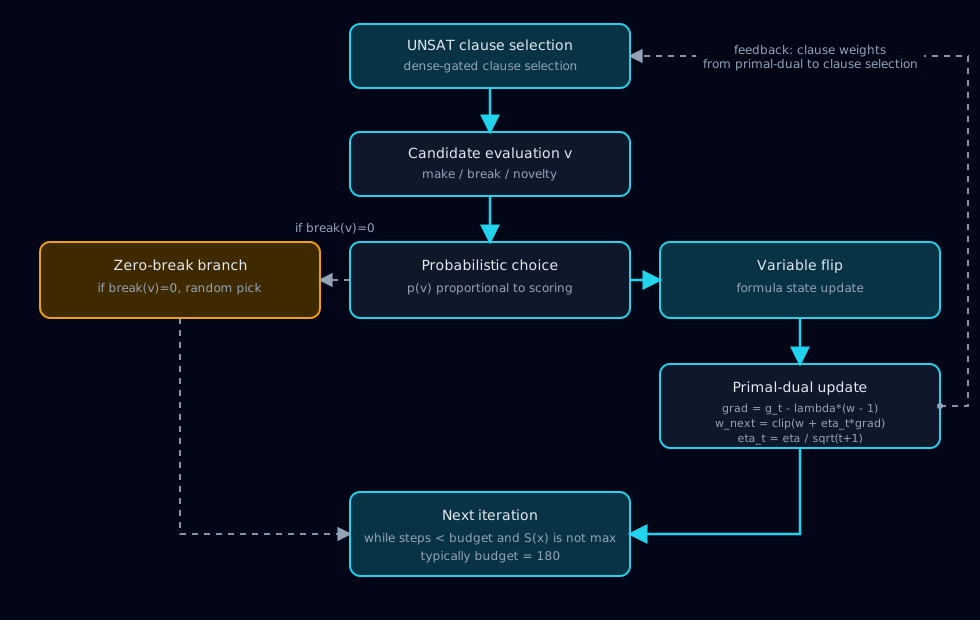
| Component | Purpose |
|---|---|
| Adaptive scoring | Dynamic flip priority via make/break |
| Clause weighting | Dynamic conflict-clause weights (dense-gated mode) |
| Size/density awareness | Parameter behavior adapted to problem scale |
| Zero-break prioritization | Dedicated path for free improvements |
Make/Break scoring
For each candidate $v$ in the selected UNSAT clause:
$$ p(v) \propto \bigl(1 + \alpha \cdot \text{make}(v)\bigr) \cdot \bigl(\varepsilon + \text{break}(v) + \text{novelty}(v)\bigr)^{-c_b} $$
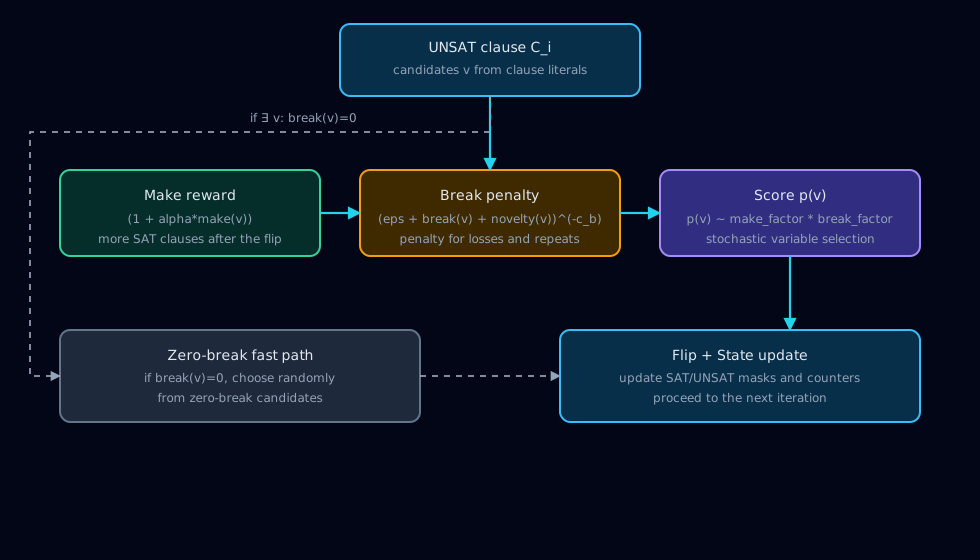
Here, make(v) is the number of clauses that become SAT after the flip, while break(v) is the number of clauses that become UNSAT. novelty(v) penalizes recently flipped variables. α (make_weight) controls the make reward strength, and c_b (cb) controls the break penalty curvature. ε ensures numerical stability.
Special case: candidates with break(v)=0 are chosen randomly within the zero-break set, preserving free gains while maintaining exploration.
Primal-Dual clause weight updates
When dense mode is enabled
Dense-gated primal-dual is enabled when:
$$ \frac{m}{n} \geq \text{dual_density_on} $$
In high-density instances, uniform weighting is usually not enough, so structured weight dynamics help target persistent conflicts.
Update equations
For a selected clause $C_i$ at step $t$:
$$ \eta_t = \frac{\eta}{\sqrt{t+1}} $$
$$ g_t = \mathbf{1}[C_i \text{ remains UNSAT after flip}] $$
$$ w_i^{t+1} = \Pi_{[w_{\min}, w_{\max}]} \left( w_i^t + \eta_t \bigl(g_t - \lambda (w_i^t - 1)\bigr) \right) $$
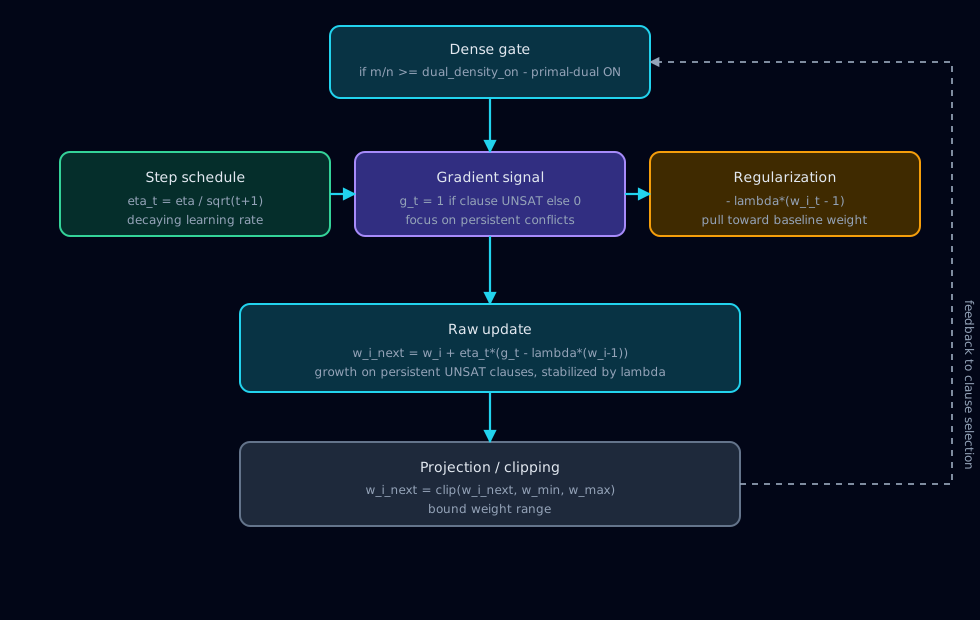
$\eta_t$ is a decaying step size, $g_t$ is the conflict signal, and $\lambda$ regularizes weights toward 1.0. Projection $\Pi_{[w_{\min}, w_{\max}]}$ keeps values bounded.
This is effectively a regularized subgradient-style dual update for MAX-SAT weighting.
Experimental results
Upper size range (n=1500-3000)
Setup: ratio = 4.267, steps = 180, random 3-SAT.
| n | prototype algorithm 8C2 | probSAT | W-WalkSAT | Δ vs probSAT | Δ vs W-WalkSAT |
|---|---|---|---|---|---|
| 1500 | 99.8359 | 99.7422 | 99.6641 | +0.09375 | +0.17188 |
| 2000 | 99.8506 | 99.7451 | 99.6836 | +0.10546 | +0.16698 |
| 2500 | 99.8383 | 99.7984 | 99.6625 | +0.03984 | +0.17578 |
| 3000 | 99.8164 | 99.7695 | 99.6270 | +0.04687 | +0.18944 |
The method leads consistently on all tested sizes.
Stability across densities
Checked at ratio ∈ {4.1, 4.2, 4.35, 4.5}, n ∈ {500, 1000}, seeds {42, 123}.
| ratio | n | prototype algorithm 8C2 | probSAT | W-WalkSAT |
|---|---|---|---|---|
| 4.35 | 1000 | 99.8333 | 99.7586 | 99.7356 |
| 4.50 | 1000 | 99.7111 | 99.7067 | 99.5689 |
A/B test: primal-dual contribution
| Mode | Success Rate | W/L vs baseline |
|---|---|---|
baseline (--disable-primal-dual) | 99.6278 | — |
| candidate (PD on) | 99.8000 | 4/0 |
Gain: +0.17222%.
Core make/break scoring fragment
// Flip probability for candidate v
const double adjusted_break = eps_ + break_count + penalty;
const double make_factor = 1.0 + make_weight_ * make_count;
const double probability = make_factor * std::pow(adjusted_break, -cb_);
Dual weight update fragment
// Decaying step size
double eta_t = dual_eta_ / std::sqrt(static_cast<double>(step) + 1.0);

// Conflict signal
double grad = unsat_mask[chosen_clause] ? 1.0 : 0.0;

// Regularized gradient
double regularized_grad = grad - dual_reg_ * (old_weight - 1.0);

// Bounded update
double new_weight = std::clamp(
    old_weight + eta_t * regularized_grad,
    dual_weight_floor_,
    dual_weight_cap_
);
Open questions and roadmap
Remaining gaps
- Regression checks for sparse regimes.
- Expanded statistical sampling to ≥10 seeds per setup.
- Less size-specific tuning and a more robust default behavior.
Next release steps
- Additional seeds
200-210forn=2000, 2500, 3000. - Reporting 95% confidence intervals.
- Further formalization of the primal-dual/subgradient interpretation.
- Comparison of adaptive bucket selection against manual tuning.
Confirmed vs. hypothesis
Confirmed:
- Better success rate than probSAT and W-WalkSAT on tested dense hard settings.
- Positive contribution of primal-dual updates in dense mode.
- Strong impact of zero-break prioritization.
Hypothesis (ongoing):
- Advantage persists at larger scales
n > 3000. - A universal config can replace size-specific tuning.
- Stronger formal convergence/regret characterization is possible.
Conclusion
prototype algorithm 8C2 is an intentional pre-release: already competitive in hard random 3-SAT settings, while theoretical and statistical finalization is still in progress.
Glossary
| Term | Meaning |
|---|---|
| SAT | Boolean Satisfiability Problem |
| CNF | Conjunctive Normal Form |
| 3-SAT | SAT variant with 3 literals per clause |
| Phase transition | Region around m/n ≈ 4.2-4.5 with hardest instances |
| SLS | Stochastic Local Search |
| make/break | Clauses becoming SAT / becoming UNSAT after flip |
| Primal-Dual | Methods updating primal and dual signals jointly |
Contact
For questions, experiment suggestions, or collaboration: email: vremyavnikuda@protonmail.com